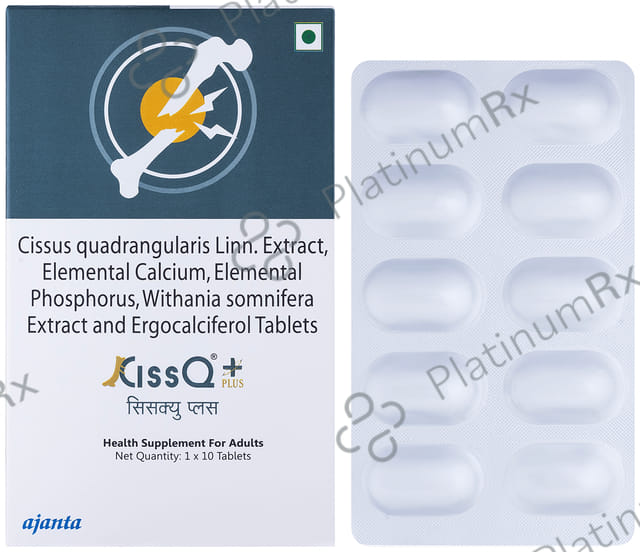
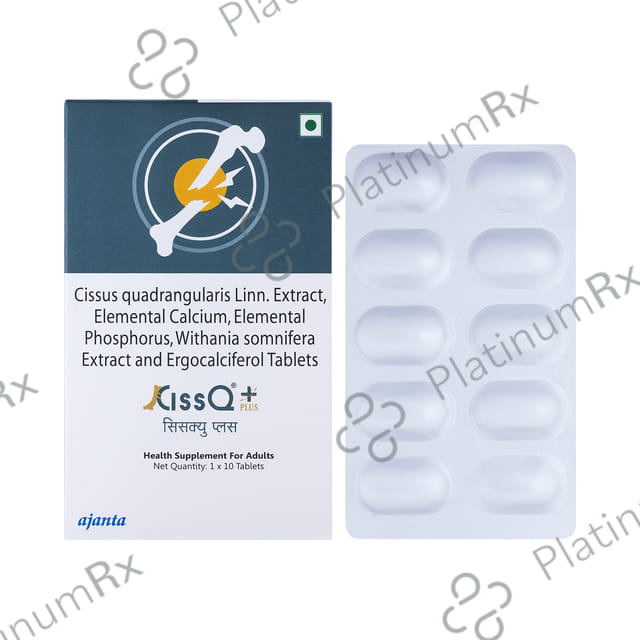
Ciss Q Plus Tablet 10s

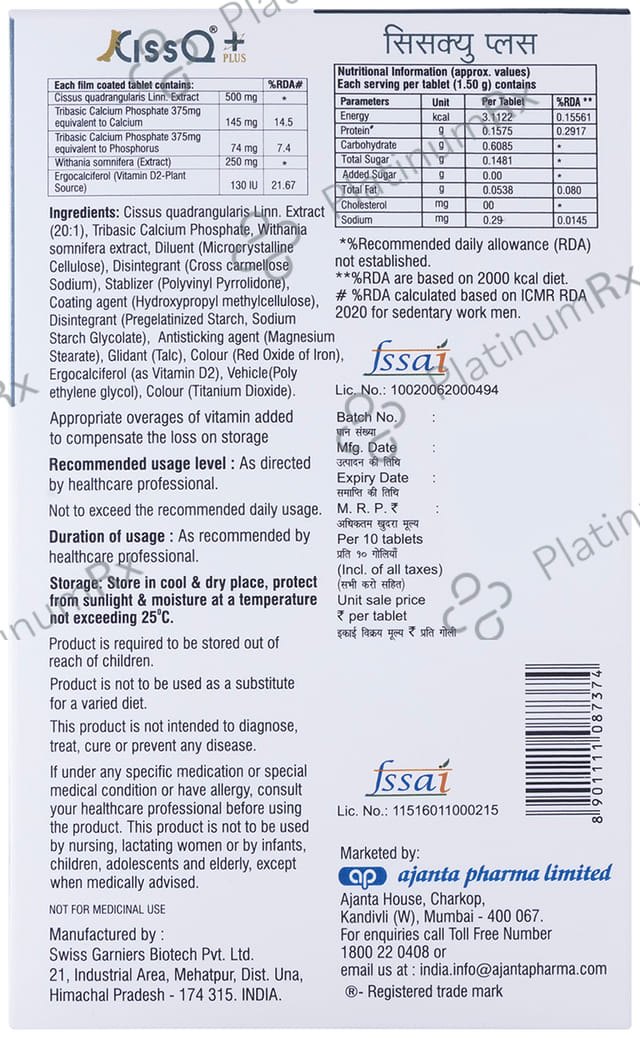
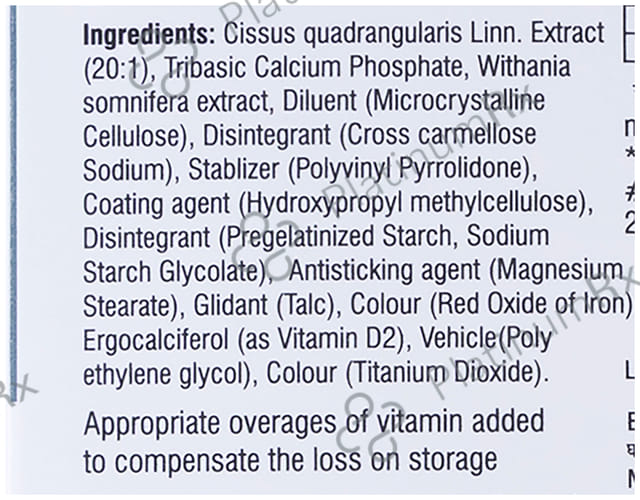
Ciss Q Plus Tablet 10s is a bone and joint support supplement that combines calcium phosphate (a source of both calcium and phosphate, the two minerals that form the structural framework of bone), Vitamin D2 (ergocalciferol, the plant-derived form of vitamin D that supports calcium absorption), and two herbal ingredients used in traditional Indian medicine, Ashwagandha (Withania somnifera) and Hadjod (Cissus quadrangularis). It is taken to support bone health, recovery from fractures, and general musculoskeletal wellbeing under medical guidance.
Written by: Syed Jommy Abbas, B. Pharma
Reviewed by: Dr. Rohit Kolhe, MBBS
Last updated on: 02-06-2026
Delivery by
...
FDA & GMP Certified
Long Expiry (>8 Months)
15 Days Easy Returns
General Information
Have a question?

Genuine Medicine
Pay On Delivery
Secure Payment

LegitScript Certified Online Pharmacy

More About Ciss Q Plus Tablet 10s
Quick Summary
Ciss Q Plus Tablet 10s is a bone and joint support supplement that combines calcium phosphate (a source of both calcium and phosphate, the two minerals that form the structural framework of bone), Vitamin D2 (ergocalciferol, the plant-derived form of vitamin D that supports calcium absorption), and two herbal ingredients used in traditional Indian medicine, Ashwagandha (Withania somnifera) and Hadjod (Cissus quadrangularis). It is taken to support bone health, recovery from fractures, and general musculoskeletal wellbeing under medical guidance.
Detailed Description
Bone is a living tissue that requires a steady supply of minerals, particularly calcium and phosphate, which together form hydroxyapatite — the crystalline mineral that gives bones their hardness. Vitamin D is essential for the gut to absorb calcium efficiently. Without adequate vitamin D, dietary or supplemental calcium is poorly absorbed.
Calcium phosphate supplies both calcium and phosphate ions, the two building blocks of bone mineral. Unlike calcium carbonate, which provides calcium alone, calcium phosphate replenishes phosphate stores as well, which is equally important for fracture recovery and in adults with low dietary phosphate.
Vitamin D2 (ergocalciferol) is the form of vitamin D derived from plant and fungal sources. Once absorbed, it is converted in the liver to 25-hydroxyvitamin D and then in the kidney to its active form, which drives intestinal calcium absorption and supports bone mineralisation.
Ashwagandha (Withania somnifera) is a herb long used in Ayurveda as a rasayana (a rejuvenative tonic) for strength, recovery, and general well-being. It contains bioactive compounds called withanolides.
Hadjod (Cissus quadrangularis) is a climbing plant native to India, used traditionally in Ayurveda for the support of bone health and fracture recovery.
Uses of Ciss Q Plus Tablet 10s
- To support bone health and skeletal strength in adults at risk of bone density loss.
- To support recovery after orthopaedic procedures or fractures, under medical guidance.
- To address combined calcium and vitamin D nutritional inadequacy.
- As traditional nutritional support during periods of physical recovery or strain.
- Strictly as directed by a qualified healthcare professional.
Benefits of Ciss Q Plus Tablet 10s
- Calcium phosphate supplies both minerals that form the bone matrix in a single source.
- Vitamin D2 supports the active absorption of calcium from the gut.
- Combines mineral supplementation with traditional Ayurvedic ingredients in a single preparation.
- Generally well tolerated when taken at recommended doses.
- Convenient to use with an everyday supplement format.
Side Effects of Ciss Q Plus Tablet 10s
Common:
- Mild gastrointestinal upset (nausea, bloating, gas)
- Constipation
- Mild abdominal discomfort
Uncommon:
- Loss of appetite
- Headache
- Loose stools
- Mild rash
Serious side effects requiring immediate attention:
- Hypercalcaemia (high serum calcium), often seen with prolonged high-dose use of Ciss Q Plus Tablet 10s, results in nausea, vomiting, excessive thirst, confusion, and/or irregular heartbeat
- Vitamin D toxicity from chronic high-dose use
- Severe allergic reaction
- Kidney stones in those at high risk
Directions for Use
Take Ciss Q Plus Tablet 10s orally with or just after a meal, as prescribed by your doctor. Swallow whole with a glass of water. Since vitamin D2 absorbs better when taken with food containing some fat, such as avocado, nuts & seeds. Maintain adequate hydration during use, and combine with a balanced diet and regular weight-bearing activity. Do not exceed the prescribed dose, and do not extend use without medical review.
How it works
Calcium phosphate breaks down in the gut to release calcium and phosphate ions, which are then absorbed across the intestinal lining. Once in the bloodstream, osteoblasts (bone-forming cells) take calcium from the blood and use it as a building block to construct the hydroxyapatite crystals that make up the mineral part of bone. This helps in maintaining the bone density and strength. Similarly, phosphate is also incorporated into this same crystal structure.
Vitamin D2 is converted in the liver to 25-hydroxyvitamin D and then in the kidney to its active form (1,25-dihydroxyvitamin D). The active form binds the vitamin D receptor in intestinal cells, switching on calcium-binding proteins and transport channels that enable active calcium absorption from the gut. It also supports calcium reabsorption in the kidney and modulates bone remodelling.
Ashwagandha is a herb that contains withanolides. These are believed to influence the body's stress response system and affect the cortisol levels. In Ayurvedic tradition, it is used as a tonic during recovery and convalescence.
Research reveals that Cissus quadrangularis has been used in Ayurveda for bone setting and musculoskeletal support, with its active plant compounds concentrated more in the stem than in the leaves.
Safety Advice for Ciss Q Plus Tablet 10s

Allergy
Unsafe
Avoid in known hypersensitivity to any component or excipient.

Breastfeeding
Caution
Safety data for the herbal components during breastfeeding are limited; consult your doctor.

Pregnancy
Unsafe
Ashwagandha is traditionally avoided in pregnancy; consult your doctor before use.

Driving
Safe
No known significant effect on alertness or driving.

Alcohol
Caution
Heavy alcohol reduces calcium and vitamin D absorption.

Liver
Caution
Severe liver disease may impair vitamin D activation; medical review advised.

Kidney
Caution
Risk of hypercalcaemia in CKD; supplement carefully under medical advice.

Children
Caution
Use only as prescribed; paediatric doses differ.

Elderly patients
Safe
Often beneficial due to reduced sun exposure and absorption.
Drug-Food Interaction
- Meals containing some fat (BENEFICIAL): Improve vitamin D2 absorption.
- High-oxalate foods such as spinach and rhubarb (CAUTION): May reduce calcium absorption.
- Bran and high-phytate foods (CAUTION): May reduce calcium absorption.
- Caffeine and alcohol (CAUTION): Excess intake of either increases urinary calcium loss.
Interactions with Other Drugs
- Levothyroxine (SEVERE): Calcium reduces absorption. Separate the two by at least 4 hours. Ashwagandha may additionally affect thyroid hormone levels.
- Tetracyclines and fluoroquinolones (SEVERE): Bound by calcium, reducing efficacy. Separate them by 2–4 hours.
- Bisphosphonates (SEVERE): Calcium reduces absorption. Take the bisphosphonate first thing in the morning and the supplement at least 2 hours later.
- Sedatives and benzodiazepines (CAUTION): Ashwagandha may have additive sedative effects.
- Thiazide diuretics (CAUTION): Reduce calcium excretion, increasing the risk of hypercalcaemia (high calcium levels in blood).
- Immunosuppressants (CAUTION): Ashwagandha may interact with immune-modulating therapy. Hence, you must consult with your doctor before taking the two together.
Drug-Disease Interactions
- Hypercalcaemia and primary hyperparathyroidism (CONTRAINDICATED): Additional calcium worsens existing hypercalcaemia.
- Sarcoidosis and other granulomatous diseases (CONTRAINDICATED): Increased risk of vitamin D-induced hypercalcaemia (increased levels of calcium in blood).
- History of calcium-based kidney stones (CAUTION): Use with adequate hydration and dietary review.
- Chronic kidney disease (CAUTION): Risk of hypercalcaemia and vascular calcification (deposition of mineral on the walls of the arteries and veins).
- Thyroid disease (CAUTION): Ashwagandha can influence thyroid hormone levels. Consult with your doctor before use.
- Autoimmune disease (CAUTION): Ashwagandha may modulate immune responses.
Overdose
Overdose can cause hypercalcaemia (nausea, vomiting, abdominal pain, constipation, excessive thirst, increased urination, weakness, confusion, irregular heartbeat) and vitamin D toxicity with chronic high-dose use. Suspected overdose requires medical evaluation, including measurement of serum calcium, vitamin D, and kidney function.
What If You Forget to take Ciss Q Plus Tablet 10s?
If you miss a dose of Ciss Q Plus Tablet 10s, take it as soon as you remember on the same day with a meal. If it is close to the next scheduled dose, skip the missed dose and continue. Do not double the dose.
FAQ
References
- https://ods.od.nih.gov/factsheets/Calcium-HealthProfessional/
- https://ods.od.nih.gov/factsheets/VitaminD-HealthProfessional/
- https://www.ncbi.nlm.nih.gov/books/NBK548536/
- https://www.nccih.nih.gov/health/ashwagandha
- https://www.nhs.uk/conditions/vitamins-and-minerals/vitamin-d/
- https://my.clevelandclinic.org/health/articles/15050-calcium--vitamin-d-supplements
Fact Box
Action Class
Bone health nutritional supplement with traditional herbal components
Chemical Class
Inorganic mineral salt (calcium phosphate); secosteroid (ergocalciferol); herbal extract (withanolides from Withania somnifera); herbal extract (Cissus quadrangularis stem)
Habit Forming
No
Disclaimer
PlatinumRx is committed to providing reliable and accurate information to support informed customer decisions. However, all information made available on the Platform, including product descriptions, comparisons, and other content, is provided solely for general informational purposes. Such information is not intended to diagnose, prevent, treat, or cure any medical condition, nor should it be relied upon as a substitute for professional medical advice, diagnosis, or treatment.

Customers also bought


More Medicines By Aksigen Hospital Care
More Medicines With Ashwagandha (Withania somnifera) 50mg + Calcium Phosphate 375mg + Hadjod (Cissusuadrangularis) 500mg + Vitamin D2 (Ergocalciferol) 130IU
Top Selling Medicines
Top Selling Devices
Top Selling Health Products


