Udiliv 300 Tablet: Uses, Composition, Side Effects & FAQs
Last Updated: October 6, 2026

Summary
Udiliv 300 is a tablet that contains ursodeoxycholic acid 300 mg. It is a bile acid medicine, prescribed for liver and bile-duct problems such as primary biliary cholangitis, and for dissolving cholesterol gallstones. It is not an approved treatment for fatty liver disease, and two controlled trials found no overall improvement in the liver itself. In India it is a prescription-only medicine, so it cannot be bought without a valid doctor's prescription.
Key Takeaways
- What it is: A bile acid tablet for certain liver and bile-duct problems.
- Active ingredients: Ursodeoxycholic acid, also called ursodiol.
- Used for: Primary biliary cholangitis, dissolving cholesterol gallstones, and a liver problem in late pregnancy.
- Not meant for: Fatty liver disease without a doctor's advice, or anyone with a complete bile duct blockage.
- Prescription: Needed in India. It cannot be bought without a valid doctor's prescription.
- How to take: Swallow whole with water, with or just after food, at the same times daily.
- Common side effects: Loose stools or diarrhoea, nausea, stomach discomfort, headache; usually mild.
What Is Udiliv 300?
Udiliv 300 is a tablet form of ursodeoxycholic acid, a bile acid that your liver makes naturally in small amounts. The number 300 is the strength: each tablet contains 300 mg of ursodeoxycholic acid. The brand is also made in other strengths, so the strength on your pack matters.
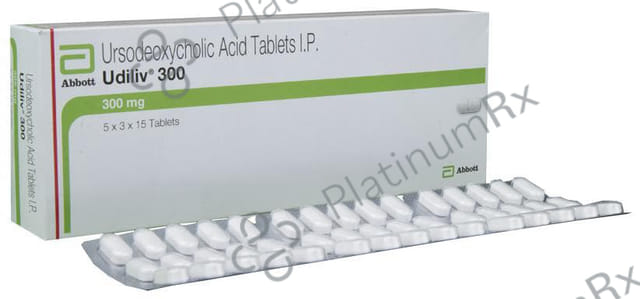
Udiliv 300 Composition (Per Tablet)
- Ingredient: Ursodeoxycholic acid; Amount: 300 mg; Type: Bile acid; What it does (in simple words): Helps bile flow and protects liver cells from harsh bile acids
Check the label on your strip, because this medicine is also made in other strengths. This article is about the 300 mg tablet, one of the strengths covered by the CDSCO recommendation of 14 November 2024. The strength on your pack should match what your doctor prescribed.
How Does Udiliv 300 Work?
Your liver makes bile, a fluid that helps you digest fat, and sends it out through tiny tubes called bile ducts. In cholestatic liver disease, where these tubes are damaged and bile cannot drain properly, bile acids build up and irritate the liver. Ursodeoxycholic acid changes the mix of acids in your bile, replacing the harsh ones with a gentler one, and it helps bile flow out.
Uses of Udiliv 300
Doctors usually prescribe Udiliv 300 for:
- Primary biliary cholangitis (PBC), a long-term condition where the body's own defences slowly damage the small bile ducts inside the liver.
- Dissolving cholesterol gallstones, small stones in the gallbladder that do not show on an X-ray, in people who cannot have surgery.
- Obstetric cholestasis, a liver problem that causes severe itching in some women in the last months of pregnancy.
- Preventing gallstones in people who are losing weight very quickly.
In November 2024, a CDSCO expert committee recommended approval for Abbott to make and market ursodeoxycholic acid 300 mg and 450 mg tablets in India for obstetric cholestasis.
Udiliv 300 does not melt away the fat in a fatty liver, and it is not a liver tonic or a supplement. It does not treat cirrhosis or repair scar tissue either.
Fatty Liver vs Cholestatic Liver Disease: Is Udiliv 300 Right for You?
- : What it feels like; Fatty liver disease (MASLD): Often nothing at all; some people feel tired or have a dull ache under the right ribs; Cholestatic liver disease (for example PBC): Tiredness and itching, and sometimes yellow eyes or skin
- : Signs to look for; Fatty liver disease (MASLD): Usually none; fat seen on a scan; Cholestatic liver disease (for example PBC): Itching, tiredness, sometimes yellow eyes or skin
- : Is Udiliv 300 suitable?; Fatty liver disease (MASLD): No, not as an approved treatment; Cholestatic liver disease (for example PBC): Yes, if your doctor has prescribed it
- : What usually helps; Fatty liver disease (MASLD): Losing weight, eating better, moving more, and controlling diabetes and cholesterol; Cholestatic liver disease (for example PBC): Ursodeoxycholic acid, plus treatment for the underlying condition
Fatty liver disease is treated first with weight loss and lifestyle changes; a few new medicines for the scarring form have been approved in the United States, but they are not established in India for this use. Taking it does not replace the weight and lifestyle changes that doctors depend on.
How to Take Udiliv 300 Tablet
- Take it with or just after a meal. Food helps your body absorb the medicine.
- Swallow the tablet whole with water. Do not crush or chew it - it has a very bitter taste.
- Take it at the same times each day so the level in your body stays steady.
- If your doctor has asked you to split a tablet, snap it along the groove. Keep the other half in a separate box and use it within 28 days.
- If you also take an antacid or a cholesterol-binding powder, ask your doctor how to space them out from this tablet.
- Finish the full course your doctor has set. Do not stop early just because your reports look better.
How Much to Take
Your doctor decides how much Udiliv 300 you take and how often. The right amount depends on your weight, your age, what is being treated, and how well your liver is working.
Never change the dose or the number of tablets on your own. A bigger dose does not work faster, and it makes loose stools and stomach upset much more likely.
There is no standard dose of ursodeoxycholic acid for fatty liver disease, because it is not an approved treatment for that problem. If a doctor has prescribed it for you, ask what they are treating and what result they expect.
For the one use where a fixed adult amount is commonly listed - preventing gallstones while you are losing weight very quickly - that amount is 300 mg twice a day. It does not apply to fatty liver.
Udiliv 300 is an adult strength. Never give it to a child unless a children's doctor has worked out the correct amount.
If you or someone else takes too many tablets, go to the nearest hospital emergency department straight away and carry the strip or box with you.
What If You Miss a Dose?
Take the missed tablet as soon as you remember it. If your next dose is almost due, skip the one you missed and carry on as usual. Never double up to catch up on a forgotten dose.
How Long Does It Take to Work?
Ursodeoxycholic acid is a slow medicine. For the conditions it is approved for, it is taken for months before the full effect shows, and your doctor checks your liver blood tests along the way. If it was prescribed for fatty liver, your liver enzyme numbers may fall, but a better number on a report does not prove the liver itself is improving - ask your doctor what to expect.
Storage
Store the tablet at room temperature, away from heat and moisture - not in the bathroom. Keep all medicines out of sight and reach of children, and check the expiry date before you take one.
Side Effects of Udiliv 300
Most people take Udiliv 300 without any trouble. When side effects do happen, they are usually mild and settle once your body adjusts.
Common and mild:
- Loose stools or diarrhoea
- Feeling sick or being sick
- Stomach pain or discomfort
- Indigestion or constipation
- Headache or dizziness
- Itching or a skin rash
- Thinning hair
Rare but serious (stop the medicine and see a doctor right away):
- Swelling of the face, lips, tongue or throat, hives, or trouble breathing
- Yellowing of the eyes or skin, or worsening of jaundice
- Severe pain in the upper right side of your abdomen
- Severe stomach pain with vomiting and bloating, which can point to a blockage in the gut
- Any new or worsening liver symptoms
The loose stools come from the bile acid itself and are more likely at higher doses. If diarrhoea does not settle, tell your doctor.
Who Should Not Take Udiliv 300
- Anyone allergic to ursodeoxycholic acid or any ingredient in the tablet.
- Anyone with a complete blockage of the bile ducts.
- Children, unless a children's doctor has prescribed it.
Precautions
Tell your doctor before taking Udiliv 300 if you have:
- Crohn's disease or any condition that slows down your digestion (rare hard stones in the gut have been reported).
- Had surgery that narrowed or joined part of your bowel (same reason).
- A gallstone your doctor has told you will not dissolve, or a gallbladder problem where surgery is the better option.
- A liver or bile-duct problem that is getting worse (your liver tests need monthly checks for the first three months, then every six months).
- Variceal bleeding, where veins in your food pipe or stomach have bled (your doctor needs to know before treatment).
Pregnancy: long use in pregnancy, mostly in the second and third trimester, has not been linked to a raised risk of birth defects or miscarriage. Even so, take it in pregnancy only if your doctor advises it — one of its approved uses is a liver problem in late pregnancy.
Not every reference agrees. Some medicine guides advise against using this medicine in pregnancy, so this is a decision only your doctor should make.
Breastfeeding: the medicine is present in breast milk and no harm to babies has been reported, but the information is limited. Ask your doctor before continuing.
Drug Interactions
- Bile acid sequestrants (cholestyramine, colestipol) — They stop your body absorbing Udiliv 300, so the medicine may not work. Ask your doctor how to space them out.
- Antacids that contain aluminium — They can soak up bile acids in the same way and reduce the effect.
- Birth control pills, HRT and other estrogens — They raise the cholesterol in bile, which works against the medicine.
- Clofibrate and other cholesterol medicines — They can counteract the medicine in the same way.
Always tell your doctor about every medicine, supplement or home remedy you are using. Alcohol does not clash with the tablet directly, but it can further damage a liver that is already struggling.
FAQs About Udiliv 300 Tablet
When to See a Doctor
Udiliv 300 will not make your liver problem go away, and it is not a substitute for treating the cause of your liver problem. See a doctor quickly if you have:
- Yellowing of the eyes or skin, dark urine and pale stools
- Severe pain in the upper right side of your abdomen, or pain with fever
- Vomiting that will not stop
- Swelling of the face, lips or throat, or trouble breathing
- New or worsening tiredness, or a liver report that is getting worse
The Bottom Line
Udiliv 300 is a prescription bile acid tablet that helps with primary biliary cholangitis, cholesterol gallstones, and the liver problem that some women get in late pregnancy. It is not an approved treatment for fatty liver disease, and it will not melt liver fat or reverse cirrhosis. The most important thing is to take it exactly as your doctor sets out, with food, and never to stop or change the dose on your own. The most common side effect is loose stools or diarrhoea, which usually settles once the dose is adjusted.
References