Telma 40 Tablet: Uses, Benefits, Dosage, Side Effects
Last Updated: September 28, 2026

Summary
Telma 40 is a prescription tablet used to bring down high blood pressure. Its active ingredient is telmisartan, a blood-pressure medicine of the angiotensin II receptor blocker (ARB) class. High blood pressure is very common - about 1.4 billion adults worldwide live with it, and two-thirds of them are in low- and middle-income countries. Keeping it under control lowers the chance of a stroke, a heart attack and kidney damage over the years. Telma 40 is taken long term, alongside a low-salt diet and other healthy habits rather than instead of them.
Key Takeaways
- Telma 40 contains telmisartan 40 mg and is used to treat high blood pressure.
- It is a prescription-only medicine in India. A pharmacy will ask for a doctor's prescription before selling it to you.
- It is usually taken once a day, at about the same time each day, with or without food.
- Keep taking it even when you feel completely well. It only works while you take it, and stopping suddenly can let your blood pressure climb again - so only your doctor should decide when to stop.
- Do not take it if you are pregnant or planning a pregnancy, and do not breastfeed while taking it.
- Tell your doctor about every other medicine you use, including painkillers, potassium supplements and salt substitutes.
- A reading of about 180/120 or higher, together with symptoms such as a severe headache, chest pain or breathlessness, needs emergency care. Call 112 or 108.
What Is Telma 40?
Telma 40 is a tablet that contains telmisartan 40 mg. Telmisartan belongs to a group of blood-pressure medicines called angiotensin II receptor blockers, or ARBs.
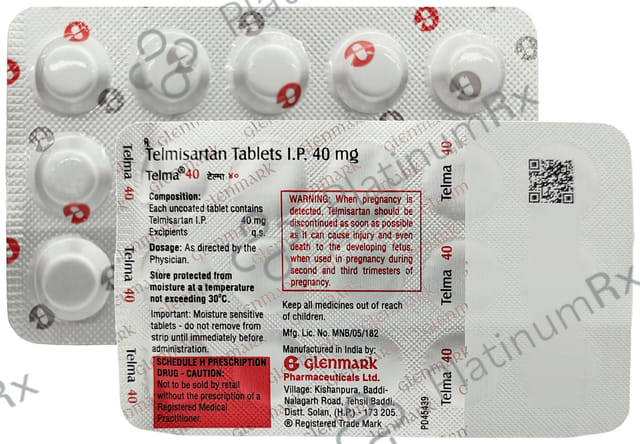
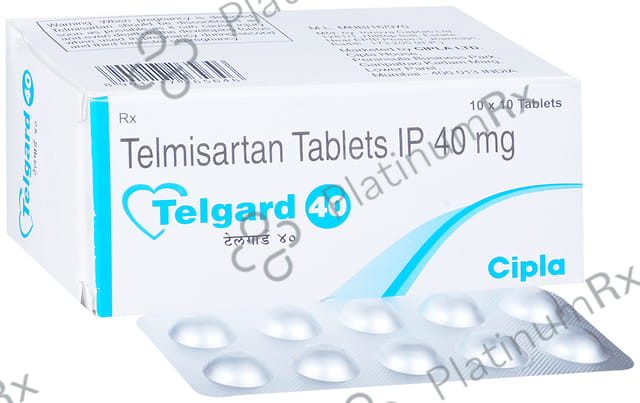
Telmisartan tablets also come in 20 mg and 80 mg strengths, so check the number printed on your strip. The same ingredient is sold in combination with other blood-pressure medicines too, such as amlodipine or hydrochlorothiazide. If the name on your strip is not Telma 40, you may have a combination product - ask your pharmacist to confirm what you have before you take it.
In India, telmisartan is listed in Schedule H of the Drugs and Cosmetics Rules. That makes it a prescription-only medicine: you can buy it only with a valid prescription from a registered medical practitioner.
Buy Telma 40 Tablet and Its Substitute at Best Price
How Telma 40 Works
Angiotensin II is a natural chemical that tightens blood vessels and signals the kidneys to hold on to salt and water. Telmisartan blocks the AT1 receptors that angiotensin II acts on.
Once those receptors are blocked, angiotensin II cannot tighten the blood vessels, and the adrenal glands release less aldosterone, so less salt and water is retained. Blood pressure falls. Telmisartan is not an ACE inhibitor - it works at the receptor rather than on the enzyme that produces angiotensin II, and it binds the AT1 receptor more than 3,000 times more strongly than the AT2 receptor.
Uses and Benefits of Telma 40
What it is used for
Telma 40 is used to treat high blood pressure in adults. It works on its own or together with other blood-pressure medicines when one is not enough. Keeping blood pressure controlled over the years lowers the risk of stroke, heart attack, heart failure and kidney disease.
The practical benefits
- One tablet a day, at a time that fits your routine, with or without food.
- No change to the usual starting dose is needed for older adults.
- It can be combined with other blood-pressure medicines, such as a diuretic or a calcium channel blocker, if your doctor decides you need more than one.
Lowering heart attack and stroke risk - a narrower use
Some adults take telmisartan to reduce the risk of a heart attack, a stroke or death from cardiovascular causes. For this purpose the labelled dose is 80 mg once a day, and it is not known whether lower doses work - a 40 mg tablet is not the strength used on its own for this.
The group this use is licensed for differs by country. US labelling restricts it to adults aged 55 years or older at high risk of a major cardiovascular event who cannot take ACE inhibitors. On that label, high risk means a history of coronary artery disease, peripheral arterial disease, stroke, a transient ischaemic attack (a temporary stroke-like episode), or diabetes with damage to organs such as the kidneys or eyes. European labelling describes the group more broadly, and with no age limit: adults with established atherothrombotic disease - coronary heart disease, stroke or peripheral arterial disease - or type 2 diabetes with documented organ damage.
Either way, this is a decision for your doctor. It is not a reason to ask for a higher dose on your own.
Sometimes used for other conditions
Telmisartan is sometimes prescribed for heart failure, and for kidney disease in people who have both diabetes and high blood pressure. These are not the labelled uses of the medicine. If your doctor has prescribed it for one of them, ask what they expect it to do for you.
What Telma 40 does not do
- It does not bring down a sudden, very high blood pressure reading - that needs emergency care.
- It is not recommended for children and adolescents under 18, because it has not been studied in that age group.
- It does not remove the need for a low-salt diet, regular activity and weight control.
- It keeps blood pressure down while you take it. It does not get rid of the condition.
How to Take Telma 40 (Dosage)
Take the tablet at about the same time every day, with water, with or without food. Your doctor sets the dose for you, and may change it after reviewing your readings. Never change the dose on your own.
- High blood pressure in most adults - Start at 40 mg once a day; the range is 40 mg to 80 mg once a day
- Lowering heart attack and stroke risk - 80 mg once a day; the group this is licensed for differs by country — see "Lowering heart attack and stroke risk" above
- Older adults - No change to the usual starting dose
- Kidney problems - Advice differs between countries: in the United States no change is needed, while in the European Union the starting dose is 20 mg once a day for severe kidney problems or for people on dialysis. Ask your doctor.
- Liver problems - In mild to moderate liver problems the dose should stay at or below 40 mg once a day; telmisartan is not used in severe liver problems
The effect builds up over time. Most of it appears within about two weeks, and it is usually full by about four weeks; European product information describes four to eight weeks. If your reading has not settled by your first follow-up, that does not mean the medicine has failed - keep the appointment and let your doctor judge.
If you forget a dose
Take the missed tablet as soon as you remember, unless it is nearly time for the next one. In that case, skip it and carry on with your usual schedule. Never double up to catch up.
If you stop
Do not stop on your own. Blood pressure usually climbs back when the medicine is stopped, often without any symptoms. If you have side effects or a reading that worries you, talk to your doctor — the dose or the medicine can be changed.
If you take too much
An overdose can cause low blood pressure, dizziness, fainting and a fast or slow heartbeat. Go to the nearest hospital emergency department straight away and take the strip or pack with you so the team knows what you took. Telmisartan is not removed from the blood by dialysis.
Who Should Not Take Telma 40
Do not take this medicine if any of these apply to you:
- You are pregnant, or you may become pregnant. This is the most serious warning on this medicine: in the United States it is carried as a boxed warning, the strongest warning a US medicine label can carry, dated December 2022. Telmisartan must not be used in the second and third trimesters of pregnancy. Medicines of this type can reduce the baby's kidney function and cause skull and lung problems, low blood pressure and, in the worst cases, death. It is not recommended in the first trimester either. If you find out you are pregnant while taking it, contact your doctor immediately - treatment is stopped as soon as possible.
- You are breastfeeding. There is no information on whether telmisartan passes into human breast milk, but because of the risk of low blood pressure, high potassium and kidney problems in a breastfed baby, the labels advise against breastfeeding during treatment. Ask your doctor about a suitable alternative.
- You are allergic to telmisartan, or you have ever had swelling of the face, lips, tongue or throat or another severe reaction to it.
- You take aliskiren and you have diabetes. This combination must not be used. The two labels differ slightly on kidney function: European labelling also lists reduced kidney function (a filtration rate below 60) as a reason not to use the combination, while US labelling says to avoid it. Tell your doctor if your kidney function is reduced.
- You have severe liver problems or a blocked bile duct. European labelling lists both as reasons not to use telmisartan. US labelling treats liver problems as a caution rather than a reason to avoid the medicine, so this is one point where the two differ.
Children and adolescents under 18 should not take telmisartan: its safety and effectiveness have not been established in this age group, and no dose can be recommended for them.
Labelling differs between countries. Read the leaflet inside your own pack, and if it says something different from this article, follow the leaflet and your doctor.
Who Needs to Be Careful While Taking Telma 40
Tell your doctor about any of the following before or during treatment:
- Kidney problems or narrowed kidney arteries. Medicines of this type can change kidney function, and advice for severe kidney problems differs between labels. Your doctor will check your kidney function.
- Losing body fluids. Diarrhoea, vomiting, heavy sweating or not drinking enough can drop your blood pressure too far and cause light-headedness or fainting. Tell your doctor if any of these happen.
- High potassium. Do not use potassium supplements or salt substitutes containing potassium unless your doctor agrees. Blood tests for electrolytes may be needed, especially if you have kidney problems, heart failure or diabetes, or if you take diuretics.
- Liver problems. Tell your doctor if your liver is not working normally. You will be started on a low dose and increased slowly, and the dose may be capped.
- Heart failure, or a previous kidney problem. Your doctor may monitor you more closely.
- Being 65 or older. No dose change is needed, but older people can be more sensitive to the blood-pressure-lowering effect.
- Driving and using machines. Dizziness, drowsiness or fainting can happen, especially in the first days of treatment. Do not drive until you know how the medicine affects you.
Side Effects of Telma 40
Most people tolerate telmisartan well. In the trials, side effects were usually mild and short-lived, and fewer people stopped treatment than those taking placebo tablets - 2.8% compared with 6.1%.
Common side effects
These were reported slightly more often with telmisartan than with placebo tablets:
- Back pain - 3% with telmisartan, 1% with placebo
- Sinusitis (blocked or painful sinuses) - 3% compared with 2%
- Diarrhoea - 3% compared with 2%
- Pharyngitis (sore throat) - 1% compared with 0%
- Upper respiratory tract infection - 7% compared with 6%
Headache, dizziness, tiredness, nausea and indigestion were also reported, but no more often than with placebo tablets - so they are not clearly caused by the medicine.
Rare but serious side effects - get help straight away
- Swelling of the face, lips, tongue, throat, eyes, hands, feet or ankles, hoarseness, or difficulty breathing or swallowing. This can be angioedema, which needs emergency treatment.
- Blistering of the skin or a rash.
- Pain or cramping in the lower leg that comes and goes when you walk or exercise.
- Kidney problems, including acute kidney failure, which have been reported rarely. Blood tests can pick these up early.
- High potassium, reported in some people taking telmisartan, particularly those with kidney problems, heart failure or diabetes, or those taking potassium supplements or certain diuretics.
- Rare cases of rhabdomyolysis, a breakdown of muscle tissue, have been reported with this group of medicines.
Very high blood pressure needs emergency care too
A reading of about 180/120 or higher with any of these symptoms — a severe headache, chest pain, dizziness, difficulty breathing, nausea, vomiting, blurred vision, anxiety, confusion, ringing in the ears, a nosebleed or an irregular heartbeat - needs emergency care. Do not wait to see whether it settles. Call 112 for emergency help or 108 for an ambulance, or go to the nearest hospital emergency department. If your reading is that high and you feel well, contact your doctor the same day.
Telma 40 Interactions
Tell your doctor and pharmacist about everything you take - prescription medicines, over-the-counter painkillers, vitamins, herbal products and supplements. Some medicines need a dose change or extra monitoring with telmisartan:
- NSAID painkillers such as ibuprofen, naproxen and diclofenac. These can reduce the blood-pressure-lowering effect and increase the risk of kidney problems.
- Potassium supplements, potassium-containing salt substitutes, and potassium-sparing diuretics. These raise the risk of high potassium.
- Lithium. Telmisartan can raise lithium levels in the blood and cause side effects, so levels need to be monitored.
- Digoxin. Telmisartan can raise digoxin levels, so monitoring may be needed.
- Other blood-pressure medicines. The effect adds up, and your doctor may need to adjust doses.
- ACE inhibitors and aliskiren. Using two medicines that act on the same system is not recommended, because it increases the risk of low blood pressure, high potassium and kidney problems. See "Who Should Not Take Telma 40" above for the warning about aliskiren in people with diabetes.
- Corticosteroids. These can reduce the blood-pressure-lowering effect.
- Baclofen, amifostine, barbiturates, strong painkillers and antidepressants, all of which can add to a drop in blood pressure.
- Alcohol. Alcohol can make dizziness and light-headedness on standing worse. Ask your doctor what is reasonable for you.
How to Store Telma 40
- Keep the tablets in the blister pack they came in. Do not open a blister until you are ready to swallow the tablet, because these tablets take in moisture from the air.
- Follow the storage advice printed on your pack. The manufacturer's information for this medicine says to keep it at 20°C to 25°C, with short spells between 15°C and 30°C acceptable, so a cool, dry cupboard is better than a warm or steamy room.
- Keep the pack away from heat, direct sunlight and damp places such as a bathroom.
- Keep it out of sight and reach of children.
- Check the expiry date. Do not use the tablets after it.
- Do not flush leftover tablets down the toilet or throw them in the bin. Return unused tablets to a pharmacy that accepts them.
FAQs
References