Normal Blood Pressure Range and Age Chart
Last Updated: October 6, 2026
Summary
Normal blood pressure is below 120/80 mmHg, and that number is the same for adults of every age. The healthy range does not creep upwards as you grow older, even though the average reading in India does. High blood pressure is diagnosed at 140/90 mmHg or higher, measured on two different days. About one in three Indian adults has it, and almost half of them do not know.
Key Takeaways
- Normal range: Below 120/80 mmHg for adults, whatever their age.
- High in India: 140/90 mmHg or higher, on two separate days.
- Average is not normal: Average readings rise with age; the healthy target does not.
- Children: Up to age 13, normal depends on the child's age, sex and height.
- How to check: Rest 5 minutes, arm at heart level, then 2 to 3 readings.
- Warning level: 180/120 mmHg or higher with symptoms needs care at once.
- Risk if ignored: Stroke, heart attack, heart failure, kidney damage and eye damage.
What Is Blood Pressure?
Blood pressure is the force of your blood pushing against the walls of your arteries. It is written as two numbers, like 120/80 mmHg: the pressure when your heart squeezes, and the pressure when it relaxes between beats. Both numbers count, and a reading is high if either one is above the healthy range.
| Category | Top number | Bottom number |
|---|---|---|
| Normal | Below 120 | Below 80 |
| Prehypertension | 120 to 139 | 80 to 89 |
| High blood pressure - Stage 1 | 140 to 159 | 90 to 99 |
| High blood pressure - Stage 2 | 160 or higher | 100 or higher |
| Hypertensive crisis | Above 180 | Above 120 |
Prehypertension means your reading is above normal, but not yet high blood pressure. For the two high blood pressure stages, either column on its own is enough.
In India, doctors usually diagnose high blood pressure at 140/90 mmHg or higher, measured on two different days. Some international guidelines, such as the 2017 American College of Cardiology and American Heart Association guideline, call 130 to 139 over 80 to 89 "stage 1 high blood pressure".
A reading between 120/80 and 140/90 is above the healthy range, so ask a doctor to review it. Either way, 120/80 or lower is the mark to aim for.
Blood Pressure Chart by Age
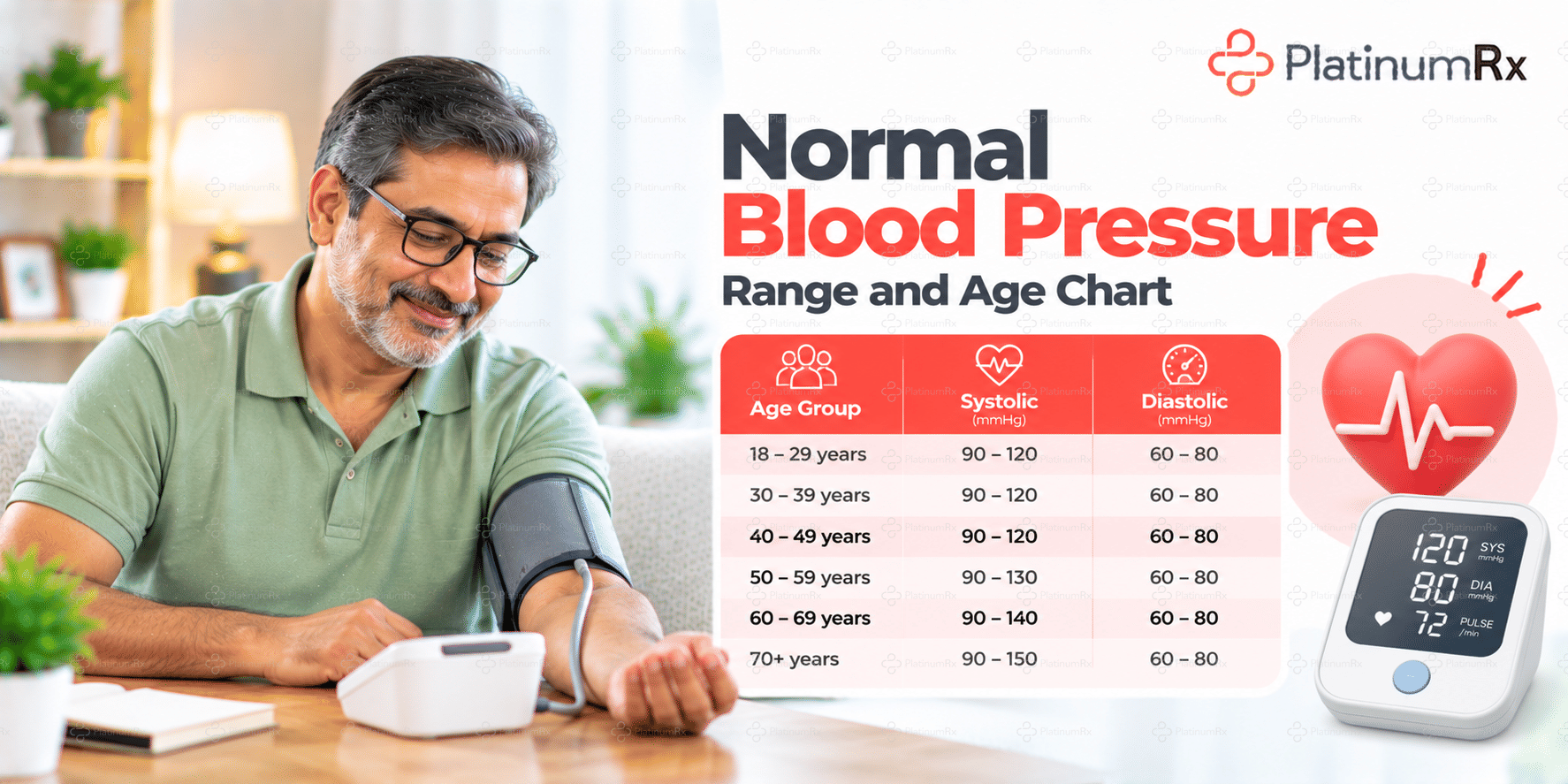
Here is the part most charts get wrong. There is no separate normal blood pressure for a 30-year-old, a 50-year-old and a 70-year-old. The healthy range stays below 120/80 at every adult age.
What does change with age is the average reading across the population. In a national survey of more than 1.8 lakh Indian adults, average readings climbed steadily with age:
| Age group | Average top number | Average bottom number |
|---|---|---|
| 18 to 19 years | 118 | 74 |
| 20 to 44 years | 121 | 78 |
| 45 to 54 years | 129 | 82 |
| 55 to 64 years | 134 | 82 |
| 65 to 74 years | 136 | 82 |
| 75 years and above | 137 | 80 |
Read that table as a picture of the country, not as a target for you. The average 55-year-old in the survey was already above the healthy range. Being average does not make a reading safe.
Two patterns are worth knowing. The top number keeps rising into old age, while the bottom number levels off and then dips. That is why many older adults have a high top number with a normal bottom number.
Doctors call this isolated systolic hypertension, and it is still high blood pressure.
Why the Average Rises With Age
Arteries stiffen as you get older. A stiffer artery pushes the top number up, because the heart pumps against a less flexible system. This is normal ageing, but it does not create a new healthy range.
Age and a family history of high blood pressure both raise your risk. That is why older adults are checked more often, not less.
Blood Pressure in Children and Teens
For children up to 13, there is no single normal number. A child's reading is compared with other children of the same age, height and sex.
Children older than 13 follow the adult rules, so the normal range is below 120/80 again.
Children of healthy weight should have their blood pressure checked every year from age 3. The cuff must fit the child's arm, because a poor fit gives a wrong reading. If a reading is high, it is measured again and the two are averaged.
Most children with high blood pressure feel completely well. It is usually found at a routine check-up, and being overweight is the usual reason.
How to Check Your Blood Pressure Correctly
Good technique matters as much as the number itself.
- Rest first. Sit quietly for 5 minutes, and 10 minutes is better.
- Skip the triggers. No tea, coffee, tobacco or exercise in the 30 minutes before.
- Sit properly. Back supported, feet flat, legs uncrossed, arm resting at heart level.
- Let the cuff fit. The cuff goes on your bare upper arm, snug but not tight.
- Repeat the reading. Take 2 or 3 readings, 1 minute apart, staying seated.
- Write it down. Note the date, time and numbers every time.
Home Readings and Clinic Readings
Readings taken at home are often a better guide than a single clinic reading. Many people feel nervous at a clinic, which pushes the numbers up. Doctors call this white coat hypertension.
Home readings run a little lower than clinic readings, so the cut-off is lower too. A clinic reading of 140/90 mmHg or higher counts as high. At home, the cut-off is 135/85 mmHg.
A common plan is to check your blood pressure before breakfast and before dinner for 5 days. That gives your doctor at least 10 readings to look at.
What Makes Blood Pressure Go Up
Some causes are outside your control. The habits you can change are covered below.
Things you cannot change:
- Getting older
- A family history of high blood pressure
- Being of South Asian ethnicity, which raises the risk
A small number of people have it because of another condition, such as kidney disease or diabetes. Some medicines, including steroids, birth control pills and certain painkillers and cold remedies, can push it up too.
Why High Blood Pressure Matters
High blood pressure usually causes no symptoms, but it goes on damaging your body the whole time. It hardens your arteries and makes your heart work harder. That can lead to a heart attack or heart failure.
It can also burst or block the arteries that supply your brain, which causes a stroke. Over the years it damages the kidneys and the small blood vessels in the eyes as well. Treating high blood pressure early is what prevents most of this damage.
How to Keep Your Blood Pressure Normal
- Cut down on salt. A high-salt diet is one of the main causes.
- Eat more vegetables and fruit, and fewer fatty and processed foods.
- Move more. Aim for at least 150 minutes of activity a week.
- Add strength work, such as weights or resistance bands, on 2 days a week.
- Lose weight if you are overweight. Even a small loss helps.
- Stop tobacco completely, and keep alcohol low.
- Check your blood pressure regularly, even when you feel fine.
- If you take blood pressure medicine, take it exactly as your doctor prescribed.
Lifestyle changes help everyone, but they are not always enough. Many people who eat well and stay active still need medicine to keep their numbers down.
When High Blood Pressure Is an Emergency
A reading of 180/120 mmHg or higher needs medical attention. Do not wait to see if it settles on its own.
Get emergency help at once if a very high reading comes with any of these:
- A severe headache
- Chest pain, especially pain spreading to your arm, neck or jaw
- Difficulty breathing
- Blurred vision or other vision changes
- Dizziness or confusion
- Nausea or vomiting
- A nosebleed or buzzing in your ears
- An irregular heartbeat
In India, call 112 for emergency help, or 108 for an ambulance. Do not drive yourself to hospital.
Frequently Asked Questions About Blood Pressure
The Bottom Line
Below 120/80 mmHg is the target for every adult, at every age. The average reading in India climbs as people grow older, but being average is not the same as being healthy. High blood pressure usually causes no symptoms, so a regular check is the only way to know where you stand. If your reading is 140/90 mmHg or higher on two different days, see a doctor.
References